Guides · Grading
New Grading System 2026: A++ to U Grade Percentages and the 40% Pass Mark
Published · Last updated · Applies from the First Annual Exams 2026
Pakistan’s boards changed how results are graded in 2026. The old A1-to-E scale is gone; in its place is a new 10-point scale that runs from A++ at the top to U at the bottom, and the pass mark rose from 33% to 40% per subject. Here is exactly what each grade means, the percentage band for every grade, and which exams and boards it applies to.
The New 2026 Grade Scale: A++ to U (with Percentages)
Every grade now maps to a fixed percentage band. This is the full IBCC scale used from the 2026 first annual examinations. Your overall grade comes from your total percentage; a single subject below 40% is graded U and must be re-taken.
| Grade | Marks (%) | What it means |
|---|---|---|
| A++ | 96–100% | Extraordinary |
| A+ | 91–95% | Exceptional |
| A | 86–90% | Outstanding |
| B++ | 81–85% | Excellent |
| B+ | 76–80% | Very Good |
| B | 71–75% | Good |
| C+ | 61–70% | Fairly Good |
| C | 51–60% | Above Average |
| D | 40–50% | Emerging |
| U | Below 40% | Ungraded — must re-appear (fail) |
Source: the IBCC grading notification (approved September 2025) as reported by Dawn and the IBCC grading FAQ. Confirm the exact grade printed on your own result card.
The 40% Pass Mark — What Changed
The biggest change is the pass mark. You now need at least 40% in every subject to pass, up from the old 33%. Anything below 40% is graded U (ungraded) — a fail in that subject, which you must re-take. Grade D (40–50%) is now the lowest passing grade. Because the bar is higher, marks that used to earn an E pass (33–39%) are now a U fail, which is why 2026 pass rates look lower at some boards.
What “U” Means: Ungraded, Unsatisfactory or Fail?
Boards and newspapers use different words for the bottom grade, which confuses many students. They all mean the same thing: a paper below 40% that you have not passed and must re-appear in.
- Sindh — “Ungraded”. Sindh’s Universities & Boards Department approved the new system on 21 January 2026, and the Sindh boards’ notification lists U (below 40%) as Ungraded. A U in any paper means re-appearing in that paper. BIEK Karachi’s first Part-I result under the rule, Pre-Engineering on 2 October 2026, used exactly this wording. See our Karachi Pre-Engineering result analysis.
- Khyber Pakhtunkhwa — “Unsatisfactory”. ARY News and TechJuice reported that BISE Bannu removed the word “Fail” from certificates and uses “Unsatisfactory (U)” instead. KP boards also promote Part-I students with one or two U papers to Part-II, but the paper still has to be cleared.
- Check your own DMC. The KP result gazettes we checked (Abbottabad, Kohat, Bannu and Mardan) still print the older grade letters on their summary pages, even though the 40% minimum applies. Whatever the label, a paper below 40% is not passed.
GPA is not part of the system yet: the IBCC deferred it “until further notice”, and Sindh says it will come only once the new grading is fully in place in all boards.
A Worked Example
Suppose you score 72% overall. Under the new scale that is a B (Good), because B covers 71–75%. If one of your subjects came to 38%, that single subject is a U and you would re-appear in it, even though your overall percentage is a B. Under the old scale, 38% was an E pass — so the same paper that passed in 2025 can fail in 2026.
Old Scale vs New Scale
If you know the old A1–E grades, here is how the system changed. The new scale has more, narrower bands at the top and a higher pass line.
Old scale (until 2025)
| Grade | Marks (%) |
|---|---|
| A1 | 80% and above |
| A | 70–79% |
| B | 60–69% |
| C | 50–59% |
| D | 40–49% |
| E | 33–39% |
New scale (2026 onwards)
| Grade | Marks (%) |
|---|---|
| A++ | 96–100% |
| A+ | 91–95% |
| A | 86–90% |
| B++ | 81–85% |
| B+ | 76–80% |
| B | 71–75% |
| C+ | 61–70% |
| C | 51–60% |
| D | 40–50% |
| U | Below 40% |
Which Exams and Boards It Applies To
The new scale and 40% pass mark apply to Part-I first: SSC Part-I (9th class) and HSSC Part-I (11th class) from the First Annual Examinations 2026. Part-II (10th and 12th class) follows from 2027. So your 11th class 2026 result uses the new A++–U scale, while the 12th class Part-II result will switch a year later.
It is an IBCC national policy, adopted for 2026 by the Federal Board (FBISE), the Khyber Pakhtunkhwa boards and the Sindh boards. Some boards, including in Punjab, may adopt it on their own timeline, so always read the grade scale printed on your own result. The Aga Khan board (AKU-EB) applies its own IBCC-aligned formula.
The Effect on 2026 Pass Rates
Raising the pass mark to 40% has visibly pushed pass rates down where boards apply a strict pass. In Karachi, the SSC Part-I (9th class) General group pass rate fell to about 36% in 2026 from roughly 54% a year earlier, which the board linked directly to the higher pass mark. At HSSC Part-I, the first 2026 results show the same pattern wherever a board reports a strict pass:
| Board | Passed | Pass rate |
|---|---|---|
| BISE Bannu | 14,845 of 17,857 | 83% |
| BISE Malakand | 30,234 of 37,233 | 81.20% |
| FBISE (Federal) | 67,848 of 105,108 | 65.31% |
| BISE Abbottabad | 29,492 of 46,452 who sat | 63.49% |
| BISE Swat | 19,772 of 31,611 | 62.55% |
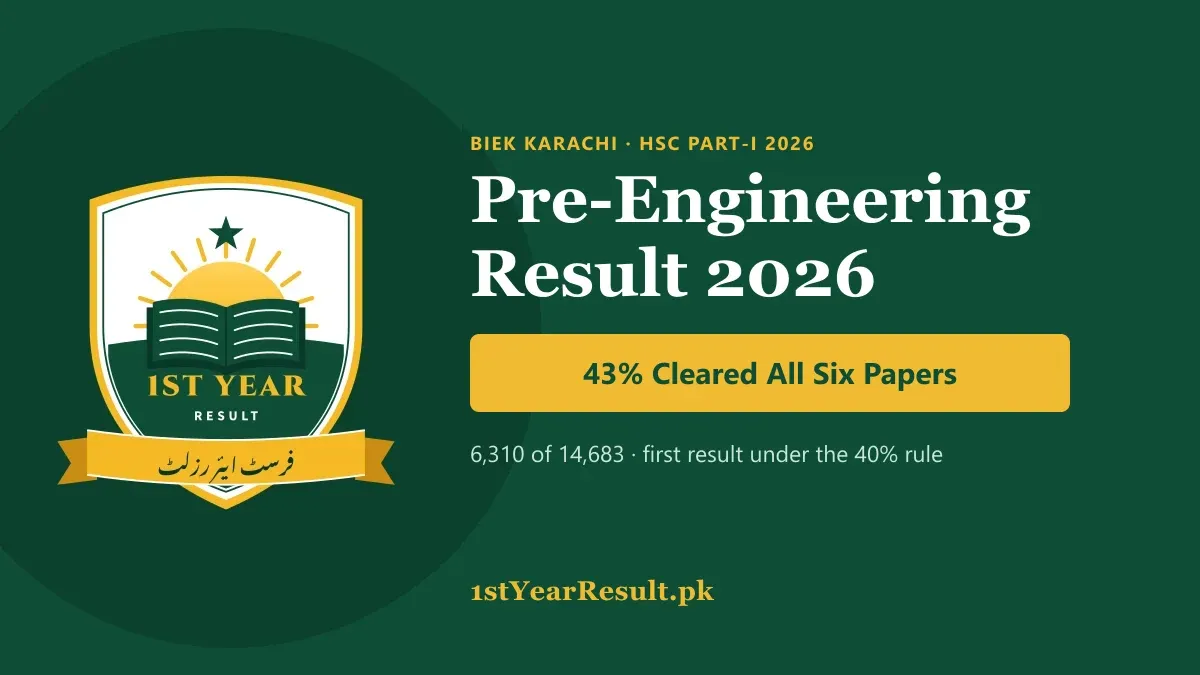
| BIEK Karachi (Pre-Engineering) | 6,310 of 14,683 cleared all six papers | about 43% |
| BISE Kohat | 6,138 of 22,728 | 27.01% |
Figures from each board’s own gazette, results page or announcement, as listed on our board pages. BIEK’s 43% is our calculation from the Controller of Examinations’ reported figures; the board did not publish a percentage.
The exception is the Khyber Pakhtunkhwa boards that promote weaker Part-I students to Part-II rather than failing them — Peshawar (99.10%) and Mardan (99.26%) report near-total pass/promotion, which masks the effect of the higher standard. So a high 2026 figure at a KP board does not mean the exam got easier; it reflects the promotion policy, not the 40% mark. If any subject reads U on your result, plan to clear it — see our 11th class rechecking guide if you think a mark is wrong.
Frequently Asked Questions
What is the new grading system in 2026?
From the 2026 annual exams, Pakistani boards moved from the old A1–E scale to a new 10-point IBCC scale: A++, A+, A, B++, B+, B, C+, C, D and U. The pass mark also rose from 33% to 40% per subject. A++ is the highest grade (96–100%) and U (below 40%) means you must re-appear.
What is the pass mark now — 33% or 40%?
The pass mark is now 40% per subject, raised from 33%. Any subject below 40% is graded U (ungraded) and must be re-taken. You need at least 40% in every subject to pass.
What percentage is an A++ grade?
A++ is 96–100%. The next grades are A+ (91–95%), A (86–90%), B++ (81–85%), B+ (76–80%), B (71–75%), C+ (61–70%), C (51–60%), D (40–50%), and U for below 40%.
Which exams does the new grading apply to?
It applies to SSC Part-I (9th class) and HSSC Part-I (11th class) from the First Annual Examinations 2026, and to Part-II (10th and 12th class) from 2027. So your 11th class 2026 result uses the new A++–U scale; the 12th class Part-II result follows a year later.
Does the new grading apply to all boards?
It is an IBCC national policy, adopted by the federal (FBISE), Khyber Pakhtunkhwa and Sindh boards for 2026. Punjab boards and some others may adopt it on their own timeline, so check the grade scale printed on your own result. AKU-EB uses its own IBCC-aligned formula.
Is 40% marks a pass or fail?
Exactly 40% is a pass — it is the bottom of grade D (40–50%). Below 40% is grade U, which is a fail in that subject and must be re-taken.
What does U mean on my result — Ungraded, Unsatisfactory or Fail?
All three describe the same thing: a paper below 40% that you have not passed and must re-appear in. Sindh’s official notification calls U “Ungraded”, and BIEK Karachi used that word in its 2026 Part-I result. In KP, media reports said BISE Bannu replaced “Fail” with “Unsatisfactory (U)”. The word changed, not the rule.
Is GPA part of the new grading system?
Not yet. The IBCC deferred GPA “until further notice”, and Sindh says GPA will come only after the grading system is fully in place in all boards. For now your result shows grades and marks, not a GPA.
Why was the grading system changed?
The IBCC raised the standard to bring Pakistani boards closer to international norms and make grades more meaningful. A side effect has been lower pass rates in some boards in 2026, since more students now fall below the higher 40% bar.
Sources
The IBCC grading notification (approved September 2025, effective First Annual Exams 2026) as reported by Dawn and the IBCC grading FAQ; the Sindh approval (Dawn, 21 January 2026) and BISE Larkana notification No. BISE/PS/CE/LRK/18/2026 (30 January 2026), issued under the Sindh Universities & Boards Department notification of 21 January 2026; BISE Bannu’s “Unsatisfactory” wording as reported by ARY News and TechJuice; 2026 board pass rates from official board gazettes, results pages and announcements, and reputable reports of them. Confirm the exact grade and pass mark on your own board’s result and notification.