News · KP Boards
Kohat Board 1st Year Result 2026: Why Only 27% of Students Passed
Published · BISE Kohat, HSSC Part-I (11th class) Annual-I 2026
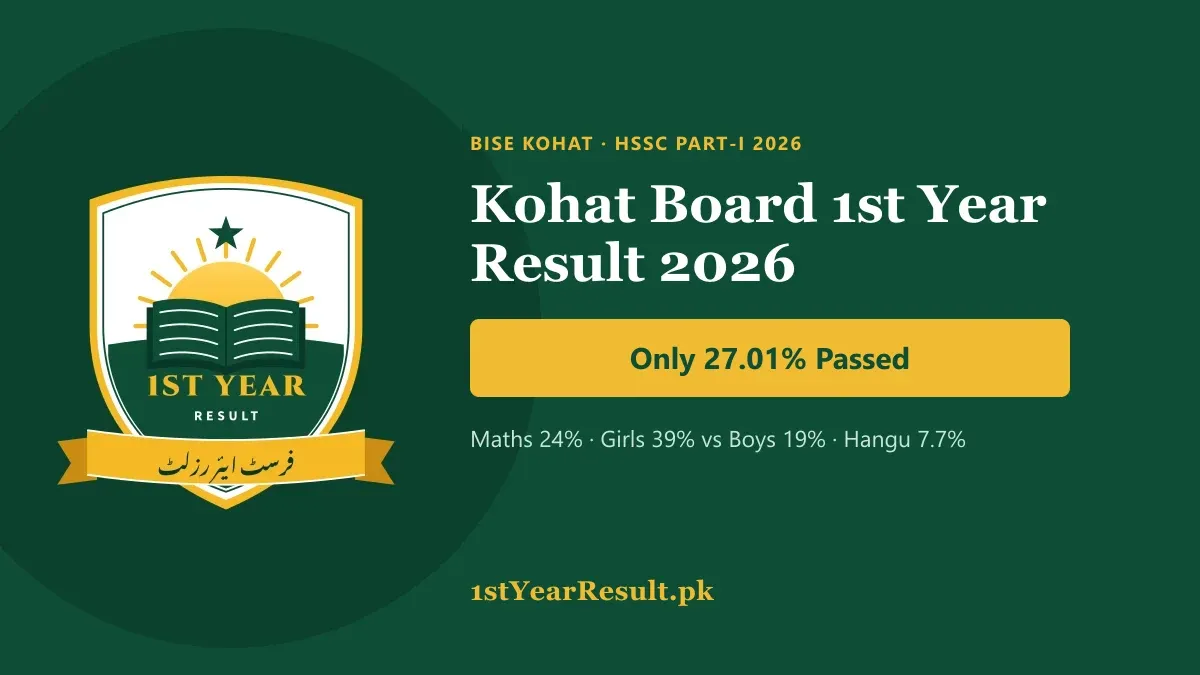
When BISE Kohat declared its HSSC Part-I result on 21 September 2026, nearly three out of four students did not pass. The Commissioner of Kohat Division publicly voiced concern about the board’s intermediate results. We went through the board’s own result gazette (subject tables, group summaries and every institution’s figures) to find where the result collapsed. It was not one thing. It was maths and science, boys’ institutions, and a few districts in particular.
Kohat Board 1st Year Result 2026 at a Glance
| Board | Board of Intermediate & Secondary Education, Kohat (BISE Kohat) |
|---|---|
| Exam | HSSC Part-I (11th class) Annual-I 2026 — papers from 6 May 2026 to 19 June 2026 |
| Declared | Monday, 21 September 2026 |
| Appeared | 22,728 |
| Passed | 6,138 — 27.01% |
| Did not pass | 16,590 |
| Regular boys vs girls | 18.99% vs 39.09% |
| Hardest subject | Mathematics — 24% passed |
| Lowest district | Hangu — 7.74% passed |
| 12th class (Part-II), same day | 9,724 of 31,496 — 30.87% |
For how to check your result by roll number or SMS, see our BISE Kohat 11th Class Result 2026 page. This article is about why the numbers came out the way they did.
Maths and Science Sank the Result
The board’s subject-wise table shows a sharp split. Language and Islamic subjects held up well. The science and maths papers that most Part-I students must take did not:
Source: BISE Kohat HSSC Annual-I 2026 gazette, “Subject Wise Pass Percentage — Part-I”. The board rounds to whole percentages.
Mathematics is the standout: 2,497 of 10,623 passed, so about 8,126 students now have a maths paper to clear. Physics, taken by almost every science student, was passed by only 38% (10,155 of 26,545). Compare Urdu at 86% and English at 74%. A candidate has to pass every paper to count as passed, so a single science failure is enough to drop out of the 27%.
Results by Group
| Group | Appeared | Passed | Pass % |
|---|---|---|---|
| Pre-Medical | 12,483 | 3,467 | 27.77% |
| Pre-Engineering | 1,298 | 317 | 24.42% |
| General / Computer Science | 5,561 | 864 | 15.54% |
| Humanities (regular) | 1,859 | 1,028 | 55.30% |
| Humanities (private) | 1,527 | 462 | 30.26% |
| All groups | 22,728 | 6,138 | 27.01% |
The General / Computer Science group, mostly ICS students taking Maths, Physics and Computer Science, had the worst result: only 15.54% passed. Pre-Medical, the biggest group with 12,483 candidates, managed 27.77%. Humanities did best overall at 44%, largely thanks to girls’ colleges.
Girls Passed at Twice the Rate of Boys
Regular girls passed at 39.09%. Regular boys passed at 18.99%, roughly one in five. Girls were ahead in every single group:
| Group | Boys | Girls |
|---|---|---|
| Pre-Medical | 22.59% | 33.20% |
| Pre-Engineering | 22.67% | 36.88% |
| General / Computer Science | 13.85% | 32.53% |
| Humanities (regular) | 16.35% | 66.53% |
The gap is widest in regular Humanities: 960 of 1,443 girls passed, against 68 of 416 boys. Our totals of the institution table point the same way. The 45 girls’ institutions passed 44.08% of their candidates, far above the board average.
Hangu and Orakzai Were Hit Hardest
The gazette has no district table, but every institution carries a code that identifies its district. Adding up the institution-wise summary by district gives this picture (regular candidates of listed institutions, 20,006 of the 22,728):
| District | Institutions | Appeared | Passed | Pass % |
|---|---|---|---|---|
| Kurram | 29 | 3,793 | 1,582 | 41.71% |
| Kohat | 82 | 6,373 | 2,041 | 32.03% |
| Darra Adam Khel (TSD) | 4 | 671 | 180 | 26.83% |
| Karak | 76 | 5,713 | 1,217 | 21.30% |
| Orakzai | 18 | 1,002 | 124 | 12.38% |
| Hangu | 41 | 2,454 | 190 | 7.74% |
Hangu stands out: only 190 of 2,454 candidates from its 41 institutions passed, which is 7.74%. Orakzai, a merged tribal district, was at 12.38%. At the other end, Kurram (41.71%) and Kohat district itself (32.03%) did better than the board average.
55 Institutions Where No One Passed
The institution-wise summary lists 250 colleges and schools. In 55 of them, not a single Part-I candidate passed. Together they entered 1,464 students. Government and private institutions were level: government institutions passed 27.15% and the rest 26.19%. So this is not simply a public-versus-private story.
The strongest results among institutions with at least 100 candidates:
| Institution | Appeared | Passed | Pass % |
|---|---|---|---|
| Cadet College Kohat | 118 | 115 | 97.5% |
| Govt Girls Higher Secondary School Lachi, Kohat | 132 | 103 | 78.0% |
| Govt Girls Higher Secondary School Billitang, Kohat | 122 | 89 | 73.0% |
| Govt Higher Secondary School Shah Salim, Karak | 189 | 133 | 70.4% |
| Govt Girls Higher Secondary School Togh Bala, Kohat | 109 | 72 | 66.1% |
| Islamic Girls Public School & College, Parachinar | 308 | 199 | 64.6% |
| Iqra Public School & College, Kohat | 295 | 186 | 63.1% |
Cadet College Kohat passed 115 of its 118 candidates. Four of the seven strongest institutions are girls’ schools and colleges (three of them government-run), which shows the board’s weak average is not universal.
Those Who Passed, Passed Well
The result is polarised. Of the 5,334 passing candidates in the institution table, 2,150 (about 40%) earned an A1 or A grade, and only 137 scraped through with a D. The gazette still prints the older A1–E grade letters, with a 40% minimum in each paper:
Our totals of the grade columns in the gazette’s institution-wise summary (regular candidates of listed institutions).
How Kohat Compares With Other KP Boards
| Board | Rate | What it counts |
|---|---|---|
| BISE Bannu | 83% | Strict pass |
| BISE Malakand | 81.20% | Strict pass |
| BISE Abbottabad | 63.49% | Strict pass |
| BISE Swat | 62.55% | Strict pass |
| BISE Kohat | 27.01% | Strict pass |
| BISE Peshawar | 99.10% | Pass + promoted (about 49% passed all) |
| BISE Mardan | 99.26% | Promoted |
Every KP board applied the same 40% pass mark in 2026. The difference is partly what each board puts in its headline. Peshawar and Mardan count students promoted to Part-II with a failed paper; Kohat reports only students who passed everything. Even among strict-pass boards, though, Kohat is far behind Bannu and Malakand. More on the promotion rule in our KP promotion policy explainer.
Kohat’s own 12th class result was weak too: 30.87% passed Part-II, declared the same day. Across both parts, 15,862 of 54,224 candidates passed (29.25%). The board also recorded 4,644 unfair-means (cheating) cases across the whole HSSC Annual-I exam and decided all of them.
If You Didn’t Pass: What to Do Next
- Find exactly which papers you failed. Your DMC shows every subject. You re-appear only in the papers below 40%, usually maths or a science.
- Re-totalling has closed. The gazette allowed 15 days from 21 September at Rs 1,500 per paper. If you applied, check the board’s portal for the outcome.
- Collect your DMC from your district camp office. These include GHSS No.1 Kohat, the EDO Office Hangu, GHSS Kalaya Orakzai, the BISE sub-office Parachinar, GDC Sadda and GHSS Karak.
- Prepare for the supplementary exam now. With maths at 24%, start with the subject that failed, not the whole syllabus. Watch for the supplementary schedule.
- Understand the grading. The 40% rule is explained in our grading system guide.
Frequently Asked Questions
What was the BISE Kohat 11th class pass percentage in 2026?
27.01%. According to the board’s own result gazette, 22,728 candidates appeared in HSSC Part-I Annual-I 2026 and 6,138 passed. The 12th class (Part-II) result, declared the same day, was 30.87%.
Why did so few students pass the Kohat Board 1st year exam?
The gazette points to science and maths. Only 24% passed Mathematics and 38% passed Physics, and Chemistry and Biology were both at 43%. Because Kohat reports a strict pass rate, failing one of these papers takes a student out of the pass column. The pass mark is now 40% in every paper under the 2026 IBCC rules, and the board did not inflate the headline with promotions.
Is Kohat’s 27% result worse than other KP boards?
It is the lowest strict pass rate published by any KP board for Part-I 2026. Bannu reported 83%, Malakand 81.20%, Abbottabad 63.49% and Swat 62.55%. Peshawar (99.10%) and Mardan (99.26%) look much higher because they count students promoted to Part-II with a failed paper, so their figures are not comparable.
Did girls do better than boys at BISE Kohat?
Yes, by a wide margin. Regular girls passed at 39.09% (3,208 of 8,207) and regular boys at 18.99% (2,468 of 12,994). Girls were ahead in every group; in regular Humanities, 66.53% of girls passed against 16.35% of boys.
Which district had the lowest pass rate in Kohat Board?
Hangu. Our totals of the board’s institution-wise summary show 190 of 2,454 regular candidates from Hangu institutions passed (7.74%). Orakzai was next at 12.38%. Kurram had the highest rate at 41.71%.
How do I apply for re-totalling at BISE Kohat?
The gazette proclamation allows re-totalling within 15 days of the result (21 September 2026), at Rs 1,500 per paper deposited in a designated National Bank branch in the board’s area. That window has now closed. An appeal against an unfair-means decision costs Rs 2,000, with the same 15-day limit.
Where can I collect my BISE Kohat DMC?
The board issues detailed marks certificates through camp offices in each district, including GHSS No.1 Kohat, the EDO Office Hangu, GHSS Kalaya Orakzai, the BISE sub-office Parachinar, GDC Sadda and GHSS Karak, as listed in the gazette proclamation.
Sources & Notes
BISE Kohat’s HSSC Annual-I Examination 2026 result gazette (Part-I & II, dated 21 September 2026): proclamation signed by Controller of Examinations Dr. Tahir Ullah Jan, subject-wise pass percentages, result at a glance and institution-wise summary. We could not find the gazette PDF on bisekt.edu.pk; the copy we read is the board’s own document as circulated online. Results are checked on the board’s . District, institution and grade totals are our own sums of the gazette’s institution-wise summary, which covers 20,006 regular candidates. Total figures and the Commissioner’s concern as reported by Pakistan Observer (23 September 2026). Other boards’ figures are from their own gazettes and results pages, as listed on our board pages.